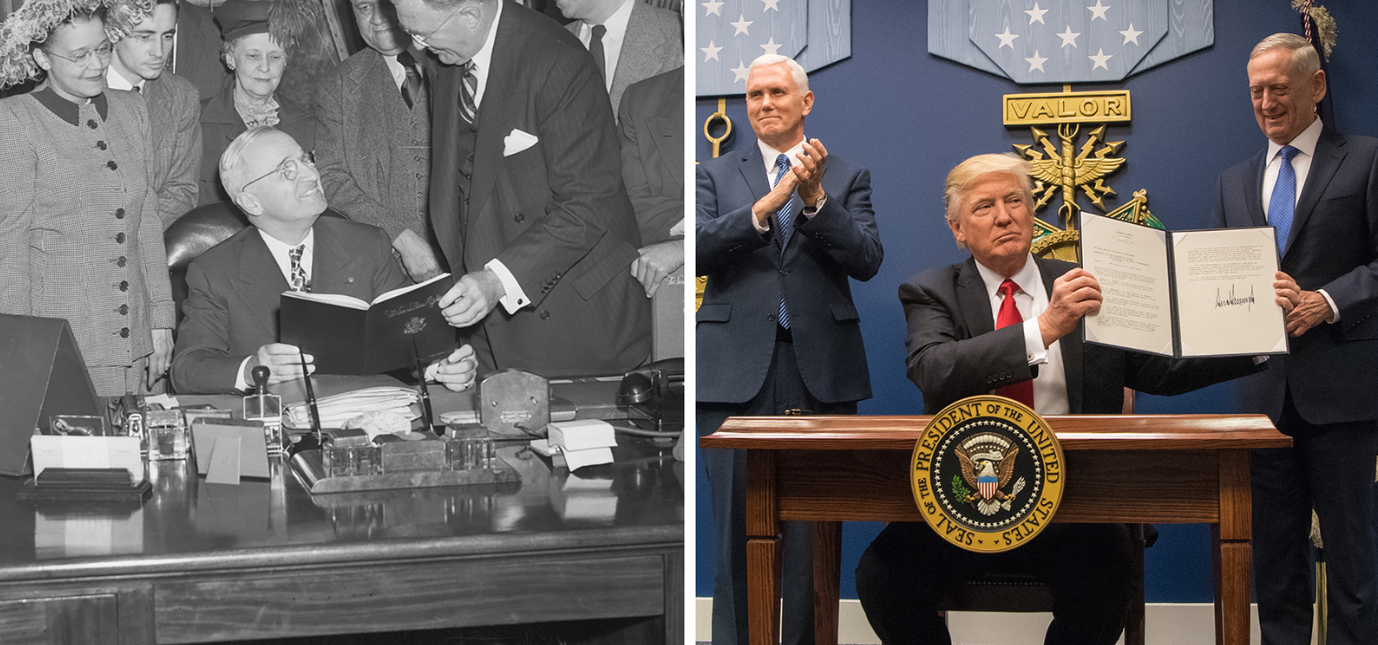
Washington — The relationship between the U.S. presidency, race, and the military has long reflected broader tensions within American society. Comparing the 1940s to the present day reveals how far the nation has come — and how many of the same debates persist in new forms.
In the 1940s, the U.S. military was deeply segregated. Black Americans served bravely in World War II but were often confined to support roles and denied equal treatment. President Franklin D. Roosevelt faced pressure from civil rights activists, including A. Philip Randolph, who threatened to march on Washington to demand fair employment and military opportunities for African Americans. In response, Roosevelt signed Executive Order 8802 in 1941, prohibiting racial discrimination in defense industries. It was a pivotal step, but integration in the armed forces would not come until 1948, when President Harry S. Truman issued Executive Order 9981, formally desegregating the military.
Truman’s decision was met with resistance within the ranks, yet it marked a turning point — the military became one of the first major American institutions to commit to racial integration. Over time, the armed forces evolved into a model of diversity and opportunity, even as broader society lagged behind.
Today, the picture is far different but no less complex. The U.S. military is one of the most racially diverse institutions in the nation, with minority service members holding key leadership positions. However, racial disparities still exist in promotions, representation among top ranks, and the handling of justice and discipline cases. The debate has shifted from segregation to equity and inclusion, raising new questions about systemic bias and institutional accountability.
Modern presidents have navigated these issues with varying approaches. Some have emphasized diversity and equal opportunity as central to military readiness, while others have framed inclusion efforts as distractions from combat effectiveness. The discussion often intersects with broader political and cultural divides, echoing the same struggle between idealism and pragmatism that defined the 1940s.
The through line between then and now is clear: the U.S. military remains a reflection of America’s racial dynamics — both its progress and its unfinished work. From Truman’s executive order to current conversations about representation and justice, each era shows how presidential leadership shapes not only military policy but also the nation’s broader pursuit of equality.